Doors/Flaps Opening time - Different approaches comparison
In this article we show the influence of Doors/Flaps Opening Time in the decompression analysis results of a 'dummy' aircraft. For this, three Opening Time approaches for Doors/Flaps are considered and compared: Instantaneous Opening, Linear Opening time and Dynamic Opening time.
Introduction
This article presents the major importance of the Opening Time of Doors and Flaps in the decompression analysis as it can bring some significant variations in the resulting differential pressure.
Three approaches of 'Doors/Flaps Opening Time' have been implemented in a typical VIP narrow body aircraft, our 'dummy aircraft', also called "Numeric Corporate Jet".
The different models considered are:
-
Model 1 - Instantaneous Opening (or NO Opening time) of Doors/Flaps: In this approach only the 'Opening Pressure' defines the opening of the feature (Doors and Flaps), no 'Opening Time' is considered. The features are considered in fully open position as soon the triggering pressure is reached.
-
Model 2 - Linear Opening of Doors/Flaps: In this model a pre-defined opening time is set for all opening features. This opening time has been previously calculated considering the size and mass properties of the doors / flaps under constant pressure (the opening pressure). In Esonix an application in the Toolbox is available to perform this kind of calculation.
-
Model 3: Dynamic Opening of Doors/Flaps: This model integrates the dynamical behaviour of Doors and flaps under the applied pressure at any given time. The opening area is not linear any more and fully depends on the differential pressure at the opening location.
NOTE: The approaches 'Instantaneous Opening' and 'Linear Opening' were encountered in decompression analysis performed by aircraft manufacturers. The approach 'Dynamic Opening' is a feature available on Esonix software, which aims to provide more accurate opening behaviour (closer to reality) by taking into account inertia parameters of opening items and actual differential pressure during run time.
The 'dummy aircraft' - Numeric Corporate Jet
The following VIP configuration is considered in this study:
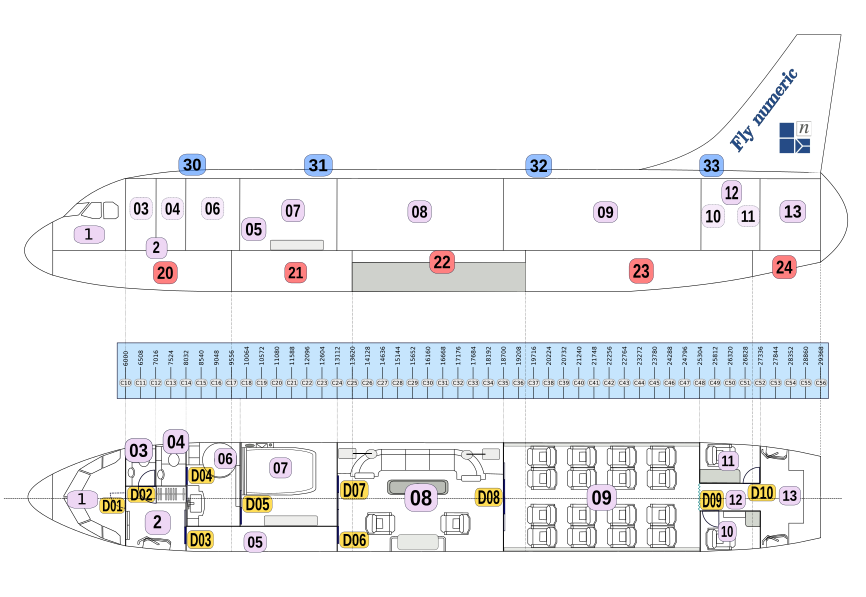
Sliding and Swivel Doors are considered in the aircraft. Sliding Doors (D03, D04, D05, D06, D07, D08) and the Cockpit Door (D01) are equipped with flaps (vent areas). The Swivel Doors (D02, D09, D10) open in case of decompression. Flaps and Swivel Doors will open at a triggering pressure ('Opening Pressure').
NOTE: All data considered in the aircraft model presented in this article are dummy data assumed as per numeric engineering experience.
Esonix Results Comparison
Results Overview
Sensitivity analysis allow us to compare the \(\Delta_P\) from the three Esonix models (three Opening Time approaches), as shown in the graph below.
It is important to highlight that all three models consider the same 'dummy aircraft' in the same configuration. The only difference between the models is the Door/Flaps 'Opening Time approach'.
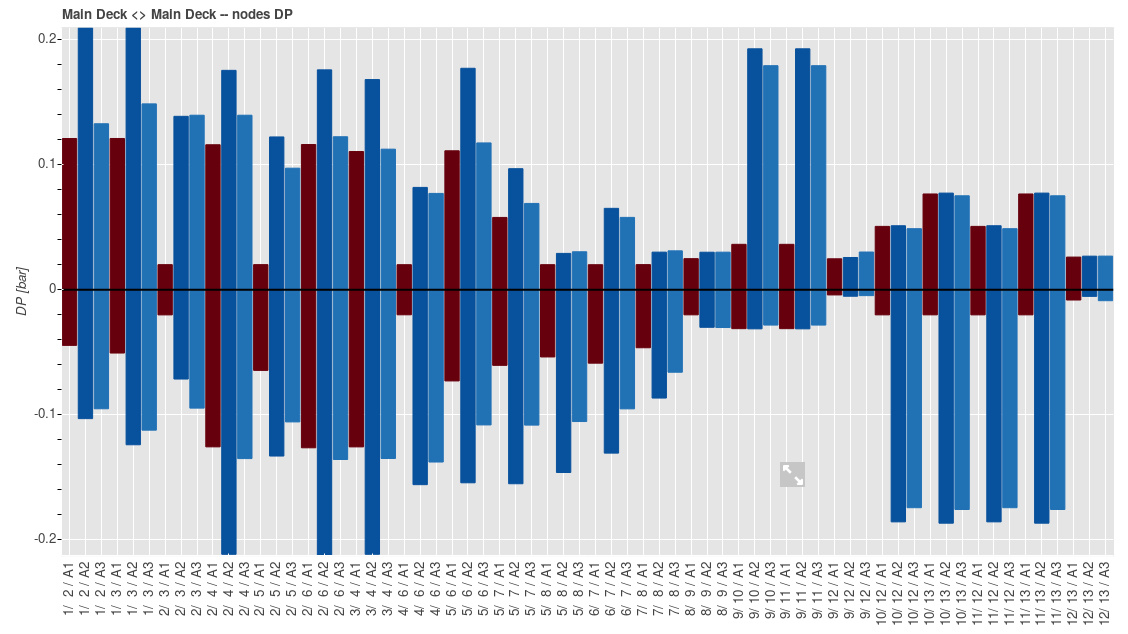
In the graph above:

- 'Dark red' columns represent the Model 1 (Instantaneous Opening);

- 'Dark blue' columns represent the Model 2 (Linear Opening Time);

- 'Light blue' columns represent the Model 3 (Dynamic Opening Time)
GENERAL CONCLUSION:
The Sensitivity results highlights the relevant difference of the '\(\Delta_P\) envelope' between the three models. It proves that the influence of the ‘Opening Time’ of Doors and Flaps is quite significant in Decompression analysis and should not be neglected.
To understand better the results, let's investigate a Flap-connection in detail.
Flap Connection investigation - Sliding Door D04
The Sliding Door - D04 - connects the Volumes #4 and #6. The figure below considers the Sensitivity analysis of the three models for the connection - D04.
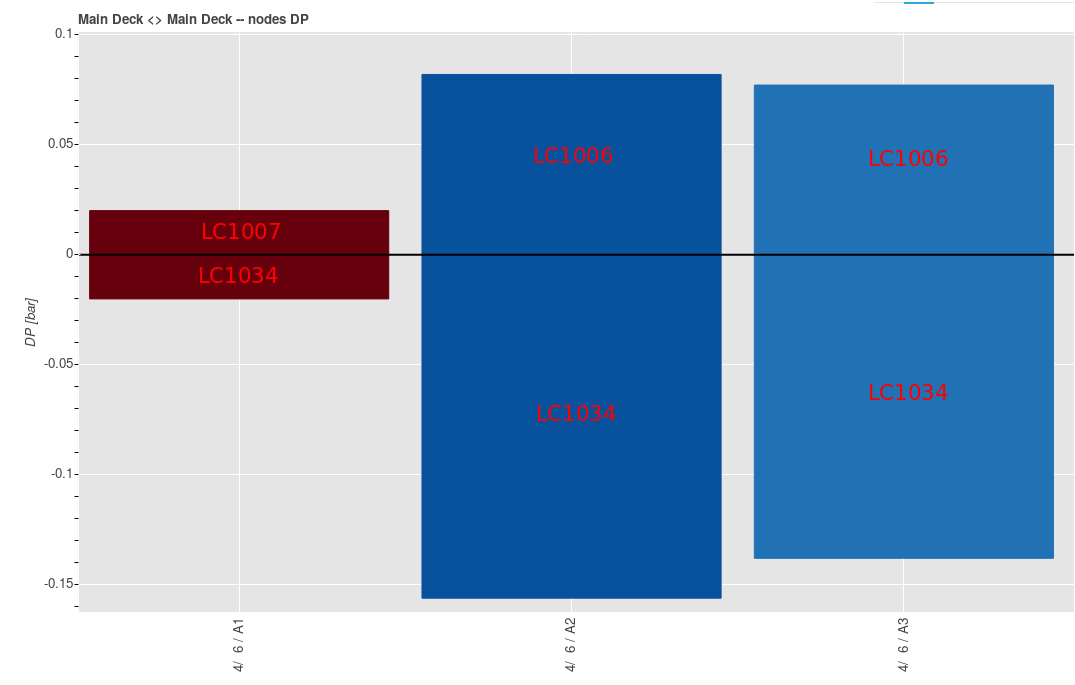
Let's investigate in detail how the 'Opening Time' acts in each model. For this, let's verify the LC1034 (highest \(\Delta_P\) for this connection) plotting - by Esonix toll 'Dynamic Plotting' -the '\(\Delta_P\)' and the 'Vent Area' in function of time, as shown in the graphs below.
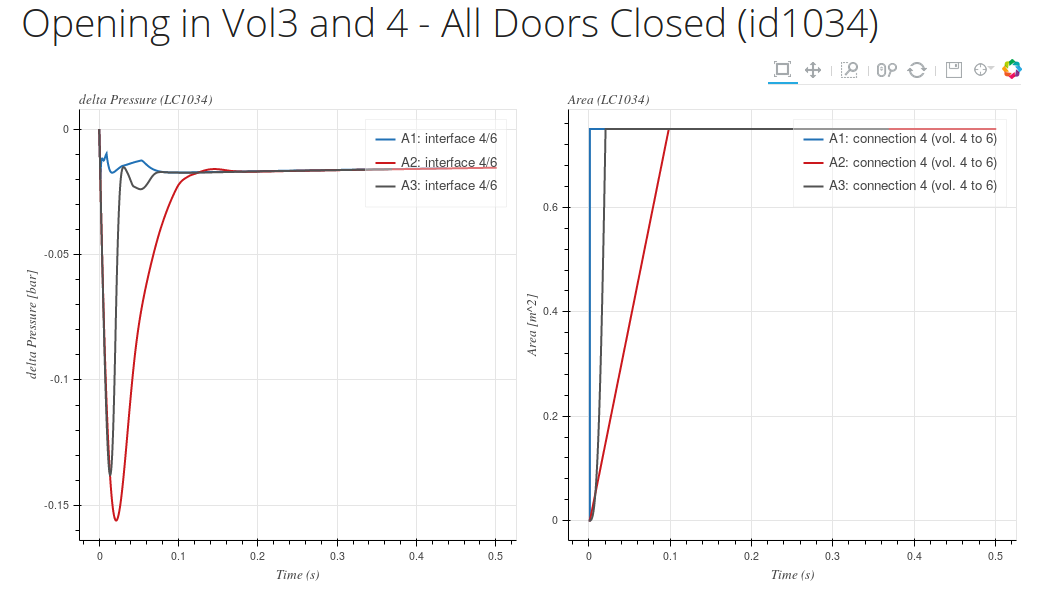
Based on the graphs above and in data generated by Esonix, some points can be highlighted:
-
In the Model 1 (Node A1) the Flap opens completely and immediately when the \(\Delta_P\) achieves the Opening Pressure of 0.02 bar, see Node A1-curve (blue) in the Area Graph. The air has no restriction to flow from Vol#6 to Vol#4, the pressure is quickly released and the maximum \(\Delta_P\) is -0.02bar (as per Opening Pressure)
-
In the Model 2 (Node A2) the Flap is completely opened at 0.0984s (Linear Opening Time of 0.097s defined by Esonix tool, opening starts at 0.014s) after the Opening Pressure achieves 0.02 bar, see Node A2-curve (red) in Area Graph. The air flow between the Vol#6 and Vol#4, and consequently their \(\Delta_P\), varies as per the linearity of the opening area. The maximum \(\Delta_P\) registered is -0.156bar.
-
In the Model 3 (Node A3) the Flap dynamically starts to open when the Opening Pressure of 0.02 bar is achieved. In this model the air flows from Vol#6 to Vol#4 according to the opening of the flap, which changes dynamically until the flap is completely open (0.0206s, see Node A3-curve (black) in the Area-graph). The maximum \(\Delta_P\) registered is -0.1379bar.
Linear X Dynamic Opening (or Model 2 x Model 3)
The difference between 'Model 1' (Instantaneous Opening) and the others is quite clear and does not requires further explanation. But how about the difference between 'Model 2' (Linear Opening Time) and 'Model 3' (Dynamic Opening Time)? And how we believe Esonix can be used to determine more accurate 'Opening Time' and consequently more accurate \(\Delta_P\)?
To answer these questions, let's explain the assumptions behind the 'Linear Opening' and the 'Dyanmic Opening':
The figure below exemplifies a typical behaviour of the 'Linear Opening' and of the 'Dynamic Opening'.
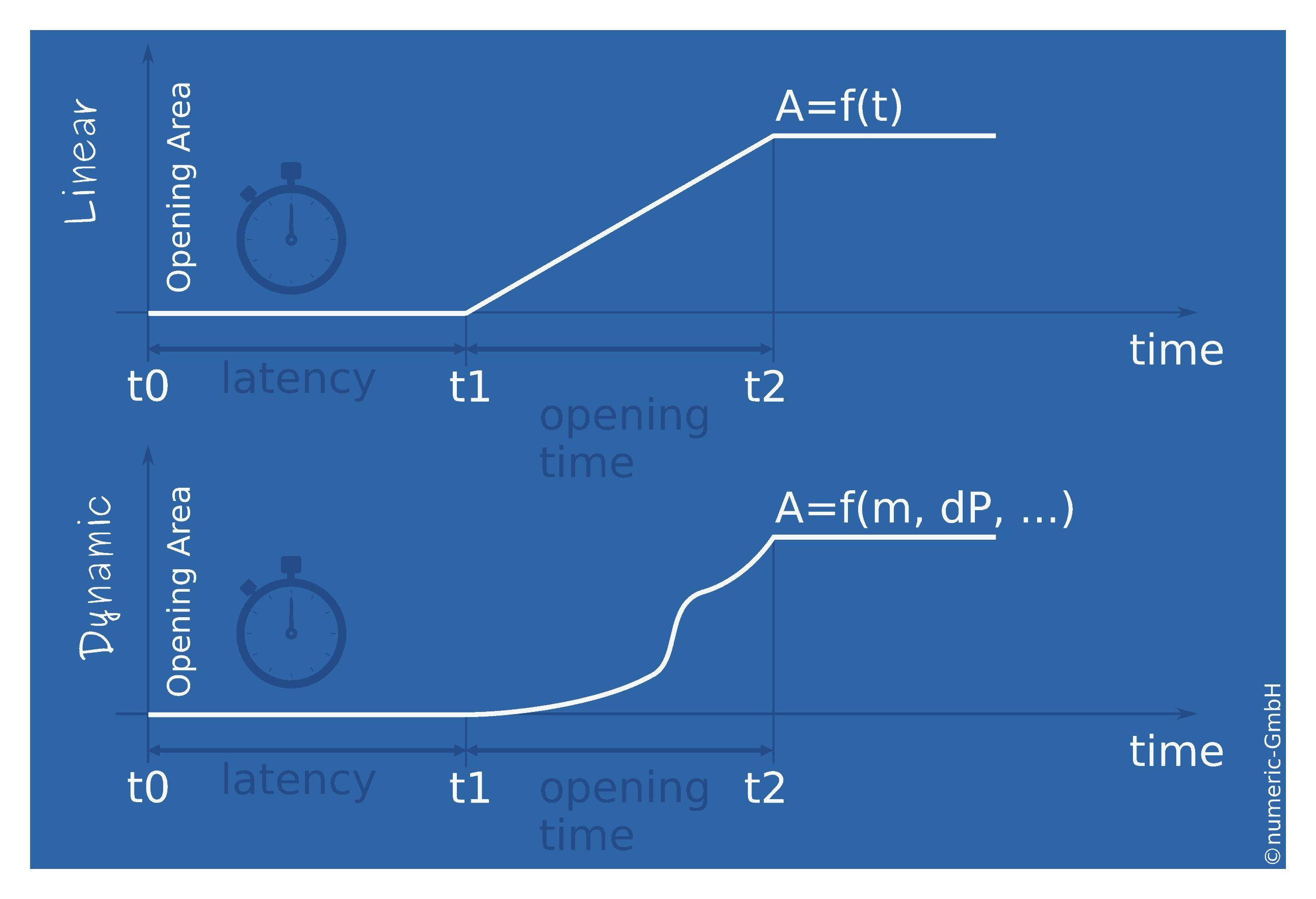
The Linear Opening assumes a 'constant \(\Delta_P\)' applied in the features (Door or Flaps) during the decompression process.
Based on this 'constant \(\Delta_P\)' and considering the dimension and mass of the feature, the 'Opening time' is calculated.
For instance, to determine the Linear Opening Time on 'Model 2', the Esonix tool Calculate hinged decompression feature opening time was used.
What this tool does is to consider the dimension of the feature (Door or Flap), the density of it (to determine the mass)
and a 'constant \(\Delta_P\)'
applied on it (normally the 'Opening Pressure'). In other words this approach assumes that the \(\Delta_P\)
applied in the feature is always constant and does not vary during the decompression process.
But in reality is easy to understand that the assumption of a 'constant \(\Delta_P\)' applied in a feature (Door or Flap), during the opening process,does not represent the reality. Thinking about how to improve this approach, the 'Dynamic Opening' option was developed and is available on Esonix.
In the Dynamic Opening approach - available by 'Dyn_Attributes' on Esonix Advanced Template -
the \(\Delta_P\) applied in the feature (Door or Flap) is not considered constant and it is checked step by step during the decompression process.
In addition to the dimension and mass parameters of the feature (Door or Flap), other parameters can also be
considered as: angle of rotation or distance of translation, direction of applied pressure, stiffness, etc.
In other words this approach checks and considers the variation of the \(\Delta_P\) applied in the feature during the decompression process and it also considers additional parameters
to calculate the 'Opening time', approaching to the reality.
Conclusion
The proper definition of 'Opening time' for the features (Door and Flaps) is relevant and important for the determination of the \(\Delta_P\) sustained internally in the aircraft due to depressurisation.
As shown by this study, a simple modification in the 'Opening time' approach can give us a huge difference in the maximum \(\Delta_P\) sustained by the parts.
The 'Dynamic Opening' approach is the Esonix proposal that aims at a better approximation of the reality in comparison to the approaches 'Instantaneous Opening' and 'Linear Opening' commonly used in decompression analysis.